
Wagers
Disclaimer: I have only ever lost money playing poker

Edit: 5/31/2025 It’s been a while since I’ve read this post, but I’m no longer a moral realist. Parfit’s wager does still look to me to be somewhat tenable as a reason to believe in realism, although it sure is a fuzzy argument that rests on a lot of assumptions.
I remember the day I disclosed to my brother that I didn’t believe in God. I must have been 11 years old, maybe slightly older. He told me our dead grandpa would be disappointed.
That entire night, I contemplated the possibility of burning for eternity.
I discovered atheism around that time. Before then, I only had an intuition about the non-existence of the Christian god. As a young, aspiring scientist, I subscribed to naturalism, the view that only natural laws and objects existed in the universe, as opposed to supernatural laws and objects. A supernatural, non-physical being that was at all times omniscient, omnipotent, omnipresent, and omnibenevolent seemed unlikely to exist, if not omnicontradictory. The internet formally introduced me to arguments to consolidate that intuition into a belief. I scoured Wikipedia for logical proof for the existence of God. The Cosmological, Ontological, and Teleological arguments—they all seemed to be properly debunked by internet atheists.
Pascal’s wager
One argument however, doesn’t make an argument for God’s existence, but rather makes an argument for why people should believe in God based on an expected value calculation. You may have already heard of Pascal’s wager:
Because
1. You should (somewhat) act in your self interest.
2. The expected value of believing in God is infinitely greater than disbelieving.
Therefore
3. You should believe in God
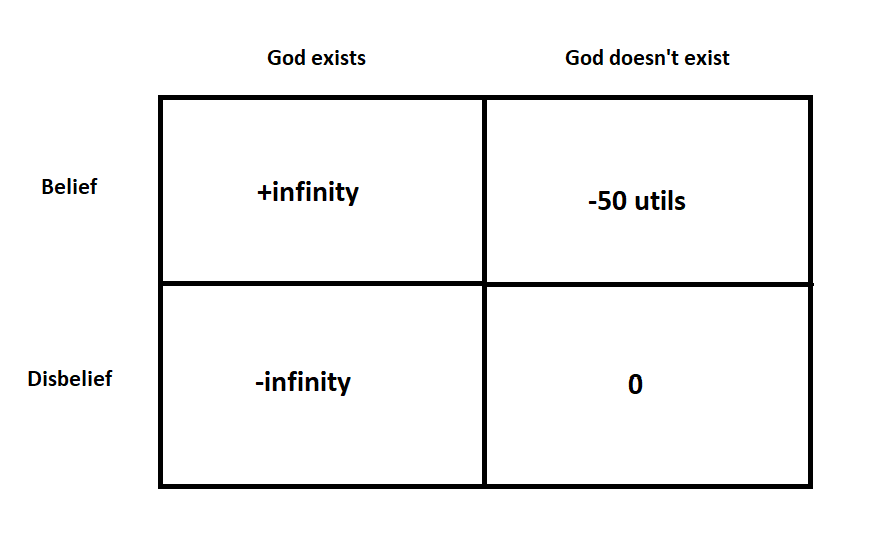
Figure 1. Artist’s depiction of Pascal’s decision matrix, 2022, ms paint
This wager has been objected to in many convincing ways, but I think there’s something appealing about arguments of this form, where the probabilities do not matter because one action is theoretically infinitely better than the other. Anyway, here are some common objections to Pascal’s wager.
1. You can’t simply believe in something just because there are benefits to having a certain belief.
There are actually two separate arguments implicit here that I think are both false. One is a prescriptive argument about what we ought to believe.
a. You should not believe in things that are false.
The other is a feasibility argument concerning whether it is possible for us to believe something we think is false.
b. It is not possible for you to believe in something you think is false.
Now, I think there are objective answers to questions of what you ought to do (see: moral realism). I'm not exactly sure what moral system is correct, but I think infinite utility probably outweighs most other considerations for what we should believe in, which would mean a. is likely false.
On b., it's not particularly easy to make yourself believe in something you find unbelievable, but I'm confident that if scientists did an extensive study on what parameters affect the likelihood some person would come to believe something, they could eventually design a protocol that would be able to convince anyone of the belief that God exists, especially through modern science. It could involve heavy social pressure. There might even be a way to do it in the future by rewiring your neurons. It doesn’t have to be that complicated. It's just not empirically impossible (relevant LessWrong post). The implementation difficulty can be overcome for infinite utility.
2. There is zero probability God exists due to X logical argument.
I think this objection fails too. Even if you are 100% certain about an argument for God not existing, that doesn’t mean the actual probability is 0. Consider the nonzero probability your logic was unsound. Then consider the nonzero probability you are having a vivid hallucination which causes you to come to the wrong conclusion in what seems to you to be a perfectly logical argument. It doesn’t matter how ridiculous this is because as long as the chance is nonzero, infinity dominates the calculation.
3. There are infinitely many gods and infinitely many infinite wagers you could make, including a trickster / atheist god who punishes belief and rewards disbelief
This one, in my opinion, makes sense. The theist response I’ve seen is that you should follow whichever wager you think there is most evidence for since rationally a higher percent chance of reward is obviously and practically better than a lower chance. There are two main problems here. One was pointed out to me by a friend, who's something of a math enthusiast. Assuming two possible gods—this probably gets a bit more complicated with infinite gods—the expected value calculation of (probability Yahweh exists)*(+infinity) + (probability trickster God exists)*(- infinity), doesn’t entirely make sense. You apparently can’t just factor coefficients out when infinity is in the equation.
The other response is that I think the probability I assign to Yahweh existing is genuinely equal or lower than the probability I assign to a trickster / atheist god. My rationale is that a god—a being intelligent and powerful beyond comprehension—would be indifferent towards our views on him. If anything, an atheist god makes more sense to me. Why not reward beliefs that are more justified?
Moral wagers
As an atheist with a scientific world view, I sometimes think about how belief in objective morality seems comparable to belief in religion. This comparison could be a topic for an entirely separate post, but it does bother me a little. It especially makes me wary to adopt Pascalian wagers for why people should act morally and possibly believe in objective morality. Of the two wagers I’d like to discuss, one, Kahane’s wager, is an argument for why we should not believe in nihilism, and the other, Parfit’s wager, is an argument for why we should believe in irreducibly normative truths.
Kahane’s wager
Nihilism is the view that nothing has final value in an objective sense. As examples, kantians (lower-case) take persons to have final value and utilitarians take utility to have final value. Other good things, like ice cream, have instrumental value in promoting some final value. With final values and nihilism so defined, Kahane’s wager is:
If nothing matters, this [the fact that nothing matters] doesn’t matter either. But if nothing matters, and we believe that, then—although it won’t matter whether anything would still matter to us—it’s likely that far fewer things would matter to us. If nothing matters then this result of belief in nihilism of course also won’t matter. But it would matter, and matter greatly, if we falsely believe in nihilism and stop, in this way, to care about the things that do matter. (347-348)
Here's the relevant decision matrix
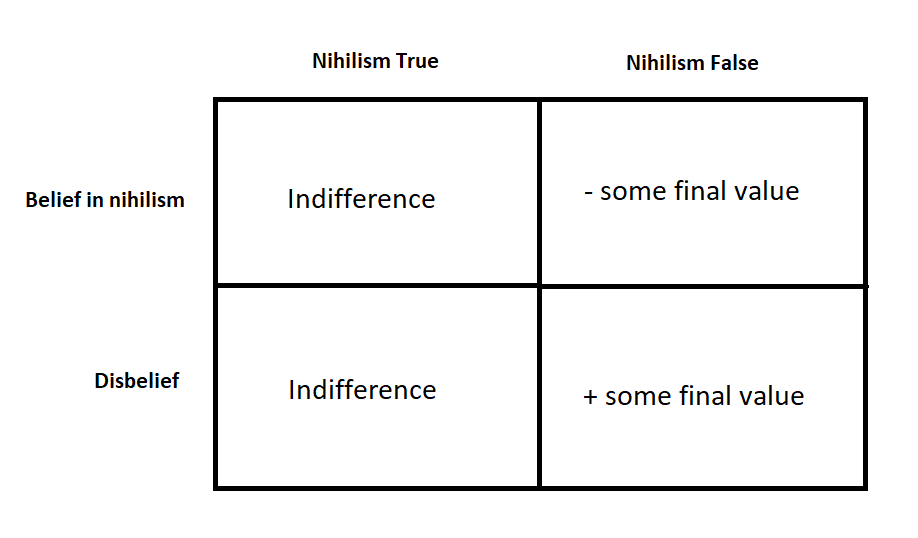
Figure 2. Kahane’s decision matrix
Defending Kahane’s wager is nice in that the successful objection to Pascal’s wager doesn’t apply as forcefully. Kahane’s wager doesn’t deal with infinities, only comparing finite values and indifference. Additionally, there aren’t an infinite number of contradictory moral systems that likely cancel out the expected value of subscribing to just one or even a few. Moral disagreement is a vast topic on its own and could be its own post, but in brief, my position is that most mainstream moral systems agree in straightforward scenarios, but disagree when they get more complicated. It looks like we make considerable moral progress over time. This argument gets stronger if one accepts Parfit’s convergence argument (that three of the most defended moral theories are actually “climbing the same mountain”). I have yet to read enough of On What Matters to see if I agree.
Tobias Beardsley points out that the wager depends on a fact of our normative psychology that our belief in nihilism would cause us to act in ways that reflect it. This effect was referred to by Kahane as “belief loss.” I think, in general, that our beliefs do affect our actions, even if just a little, and that nihilism is no different. One’s belief in nihilism could potentially be a factor that causes them to act in ways detrimental to some hypothetical scale of final value. I’m not saying that every nihilist immediately jumps off a bridge, but maybe belief in nihilism has a causal effect on increasing suicide rate by providing easier justification for it. Maybe it helps justify why it’s okay to do something small, like stepping on ants when nobody’s looking. If I had to place a probability on it, I’d say it’s at least above 50%. Maybe 70%. At the very least, Kahane’s wager is an argument against allowing your nihilism to affect your behavior in any way.
Parfit’s wager
Pascal’s wager makes an argument based on prudential reasons. It assumes that you should, roughly, do what you have self-interested reasons to do. Parfit’s wager is different in that it appeals to normative reasons.
It’s a little difficult to describe what is exactly meant by normative, but for our purposes, it can be approximated as having some property of moral authority. This may seem mysterious and perhaps is another topic for another post. Parfit thinks that “reason” is a bedrock concept for the existence of normative / moral truths. He thinks that there are irreducibly normative reasons. One candidate for an irreducibly normative reason could be that we all have reason to avoid pain. It would be irreducible because there is no further fact that can explain why this reason is normative. I can now introduce what has been called Parfit’s wager:
If we believe that there are some irreducibly normative truths, we might be believing what we ought to believe. If there are such truths, one of these truths would be that we ought to believe that there are such truths. If instead we believe that there are no such truths, we could not be believing what we ought to believe. If there were no such truths, there would be nothing that we ought to believe. Since
(D) it might be true that we ought to believe that there are some irreducibly normative truths,
and
(E) it could not be true that we ought not to have this belief, we can conclude that
(F) we have unopposed reasons or apparent reasons to believe that there are such truths,
so that
(G) this is what, without claiming certainty,
we ought rationally to believe. (619)
And the decision matrix:
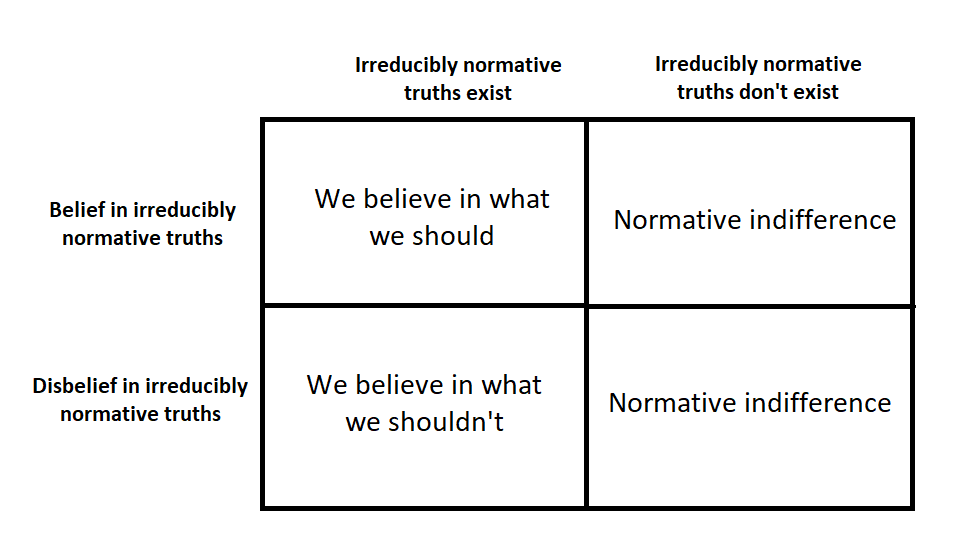
Figure 3. Parfit’s decision matrix
As Beardsley pointed out, this argument does not depend on facts about our psychology. However, it does depend on whether, if irreducibly normative truths exist, one of those truths is that we should believe that there are such truths. In other words, I think that (E) is not necessarily true. It could be true that we ought not to believe what is true.
In which case the decision matrix for Parfit’s wager actually looks more like this.
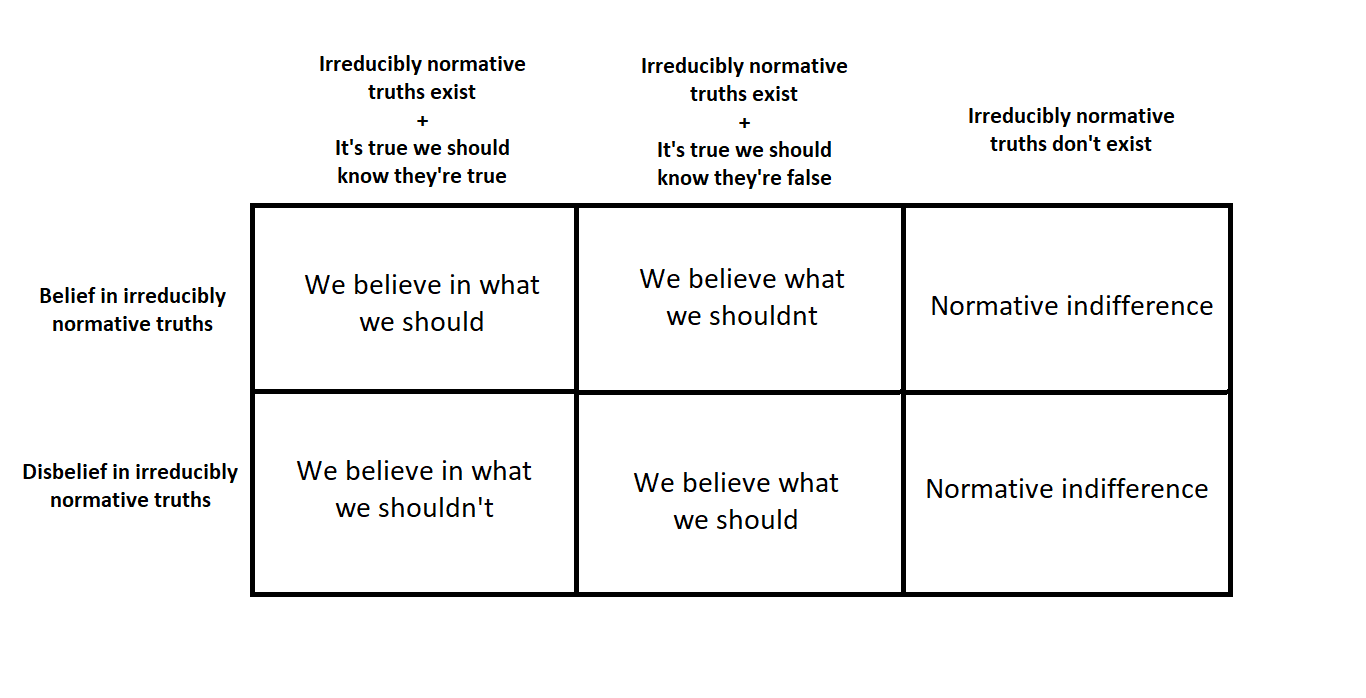
Figure 4. The actual decision matrix for Parfit’s wager. I think the expected value for belief is still higher since the probability of the first column is greater than the second.
My assumption, based on if there is such a thing as an objective morality that depends on irreducibly normative reasons, is that it probably would be true that we should believe these truths. Some utilitarians have intelligibly argued that acting under the principle of utility in all circumstances is unlikely to maximize utility. I think an analogous objection might be present here against the premise that we ought to believe that there are irreducibly normative truths, but my guess at the probability of that objection succeeding is pretty low. It would probably be an irreducibly normative truth that we should believe in irreducibly normative truths.
Combining both wagers
In a vacuum, Parfit’s wager is overall less powerful than Kahane’s wager. Parfit is aided by the fact that he dedicated a thousand-page long book about the implications of irreducibly normative truths and the convergence of kantian, contractualist, and consequentialist thought. So really, depending on how strong the rest of his book is, he only needs to prove that we have reasons to believe in irreducibly normative reasons whatsoever to get you on board to the rest of the philosophy. Kahane’s wager, on the other hand, doesn’t seem to mind what your beliefs are, as long as your behavioral choices preserve final value.
Kahane’s wager does depend on the truth of an empirical claim about our psychology, while Parfit’s wager depends on the truth of a conceptual claim. I think both of these claims are more likely true than false, and therefore these wagers seem to be somewhat successful. On some level I believe they do give us reasons to act and believe as though an objective morality does exist.
I’ve long since gotten over my fear of burning for all eternity. At some point in my life my fear of burning got replaced with an existential fear of death, influenced by a feeling that everything we’re doing on this pale blue dot was meaningless. I don’t really get existential dread anymore because I work a stupid busy job, and I have far too little time to be actually emotionally invested in these things instead of rock climbing, watching Youtube, and sleeping. At the very least I think this stuff is interesting to think about.
Works Cited
Beardsley, Tobias. “Can Pascal’s Wager Save Morality from Ockham’s Razor?.” Philosophia, vol. 50, 2022, pp. 405–424., https://doi.org/10.1007/s11406-021-00396-6
Kahane, Guy. “If Nothing Matters.” Noûs, vol. 51, no. 2, 2016, pp. 327–353., https://doi.org/10.1111/nous.12146.
Parfit, Derek. On What Matters. Oxford University Press, 2017.